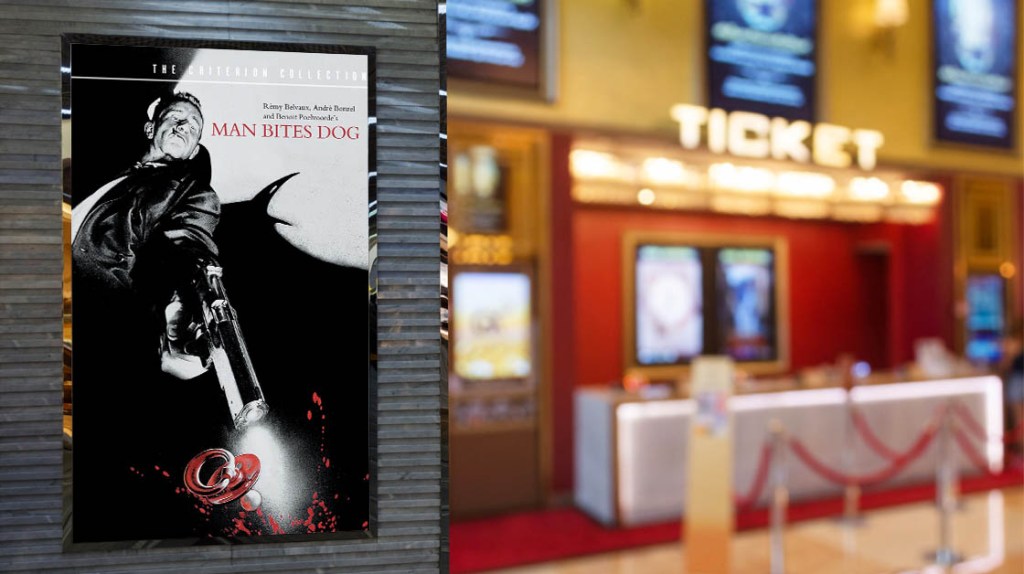
By Tony Frame. Contains very mild spoilers.
This Belgian black and white 16mm film was made by three students (Rémy Belvaux, André Bonzel, Benoît Poelvoorde) on a total budget of $15,000. It was meant to be shot over six weeks, but due to financial hardship it ended up being filmed over a two and a half year period. The filmmakers took it to Cannes in 1992 where everyone went wild for it (it won two awards there). Quentin Tarantino was an audience member in the first screening there. He loved it. The film was subsequently banned in a number of countries due to its violent content, but its critical reception was mostly positive, with many reviewers and publications praising it for its originality despite its excessive violence.
The film is an experience and a half. It puts you (the viewer) in a strange place of watching a documentary (technically a mockumentary) about the exploits of a mass-murderer who does some horrendous things, but you’re actually are enjoying it, and if you’re not enjoying it then you’ll probably keep watching anyway, because you want to see what happens next. It’s hypnotic cinema. It’s like driving past a car crash; you’re horrified yet captivated, you’ll probably turn your head and look away, but another part of you wants to keep looking. Man Bites Dog is the celluloid embodiment of that scenario. Ben is the protagonist, but at the same time he’s the antagonist; he recites poetry and is cultured, enjoys fine dining and appreciates the struggles of the working man, but he’s a stone-cold killer who kills everyone and anyone: from children to old people to his friends; he doesn’t discriminate who his victims are. His motives for killing can be for money or for convenience, but mostly it’s because he enjoys it. Over the course of the movie he forms a close relationship with the camera crew and the director, and in a way we also bond with him. He’s a likeable guy, even when he does the most horrific things. Kind of like Joe Pesci’s Tommy De Vito in Goodfellas.

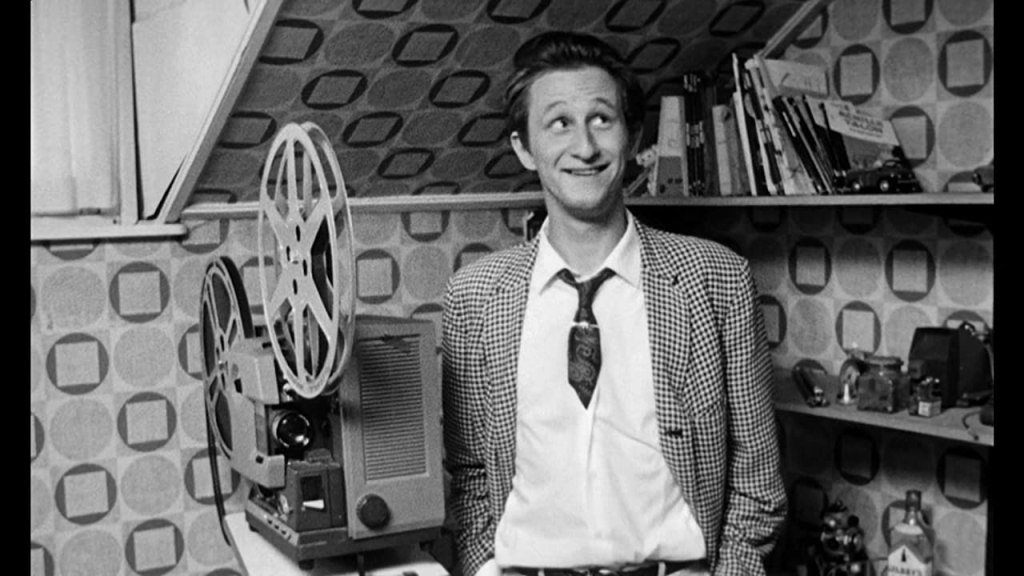

Many films have copied Man Bites Dog over the years, and many have failed in capturing its tongue-in-cheek humour and its satirical point of view. But even to this day the film is still very much unheard of by the average film fan. It never appears on those greatest films of all time lists that the mainstream publications publish every so often. And I’ve yet to see it on a streaming platform. If it was an English language film (and was in colour) it would probably be talked about more often. The fact that it isn’t only gives it more of a cult status and makes it a hidden gem for those who come across it for the first time. It’s also a testament to pissing all over the old adage that the protagonist in a book or a film (or a TV show) has to be a good person for you to like them. I hate that mindset with a passion. Good, bad – these are just a point of view. Reality is just a state of mind. The most important thing for a character is that they are engaging. Whether they’re good or bad is almost irrelative. If they are engaging, you will subconsciously like them, because you’re enjoying their time on the screen. When people came out the cinema after watching The Silence of the Lambs I guarantee you that not one person said they loved Clarice Starling and went into detail about her character and what she did in the movie. As good as Jodie Foster was in that movie all everybody talked about afterwards was Hannibal Lecter and Anthony Hopkins’ portrayal of that character. Hannibal, Hannibal, Hannibal. Everyone and their children in the schoolyard were reciting, “I ate his liver with some fava beans and a nice chianti,” until the cows came home.
If Man Bites Dog was released now it would be all over social media like wildfire, and the internet would probably blow up because of its polarising opinion amongst audiences and critics. Everyone wannabe filmmaker would be out in their neighbourhood filming their version of it, hoping to make a million bucks from it. And although there hasn’t been any real proof, I’d put money on saying that the filmmakers of The Blair Witch Project took inspiration from it when they went out into the woods and created their 1999 horror masterpiece. I would even go so far to cite Man Bites Dog as the grandfather of the found-footage genre.
It could also be argued that Man Bites Dog is the greatest Independent movie of all time. It’s certainly up there with the likes of Easy Rider, Slacker, The Texas Chainsaw Massacre, Night of the Living Dead, Sex, Lies and Videotape, et al. Financially it made very little compared to most of those films, and it definitely didn’t make huge stars of its cast or crew (Rémy Belvaux committed suicide in 2006). But unlike those aforementioned movies, Man Bites Dog’s themes and our questionable relationship watching it were prophetic in the way the media became more sensationalistic and brazen with its content from the ’90s onward, and the way real life audiences kept watching what they were watching, regardless of the moral implications of contributing to the viewership of that content.
Such examples would be the live-feed news coverage of the O.J. Simpson high speed car chase and, to some degree, the attacks on the twin towers on 9/11. Talk shows like The Jerry Springer Show and (in the UK) The Jeremy Kyle Show, with their setups of sometimes putting opposing extremist groups on the stage and watching violence erupt between them, or having vulnerable family members on the air whilst the audience cheered and clapped at their misfortune, was exactly what Man Bites Dog encapsulated in some of its scenes. The movie’s themes are even more relative now with the problematic content that pops up on social media channels every so often: where Tik-Tok trends and challenges and videos of people asphyxiating themselves are shared countless times, where clips of bullies in the playground garner thousands of views as they kick the crap out of some poor schoolkid (just like Ben in the film as he assaults and robs a postal worker which is a weekly ritual for him).
The filmmakers of Man Bites Dog were very aware of what they were doing when they wrote and made their film; they understood humanity’s interest (and sometimes obsession) with violence and fame (and to some regard, infamy). These things haven’t changed. There’s even more demand for True Crime content now than ever before (read more on this from an insightful article in The Guardian). The film was ahead of its time in understanding the relationship the camera has with its subject and the connection and bond that ultimately forms with the viewer. If a main subject is interesting (or made interesting, whether it’s through editing, its production values or the way it’s shot) then the average viewer will be invested. Once they are invested they will almost accept whatever rabbit hole the show and its protagonist (real life or not) take them down. It’s why reality TV shows like The Kardashians still get huge viewing figures. It’s the reason there’s a whole army of influencers out there streaming every aspect of their lives.
If I had to pick just five films to take with me on a desert island then I could categorically state that this little known Belgian film would be one of those movies. There’s nothing quite like it.
Directors: Rémy Belvaux, André Bonzel, Benoît Poelvoorde
Writers: Rémy Belvaux (story), André Bonzel (screenplay), Benoît Poelvoorde (screenplay)
Stars: Benoît Poelvoorde, Jacqueline Poelvoorde-Pappaert, Nelly Pappaert
This article was updated 22/7/24.
 Gonzo Magazine
Leave a comment