★★★★☆
Review by John Gibson. Venue 53 – TheSpace @ Surgeons Hall – Theatre 1.
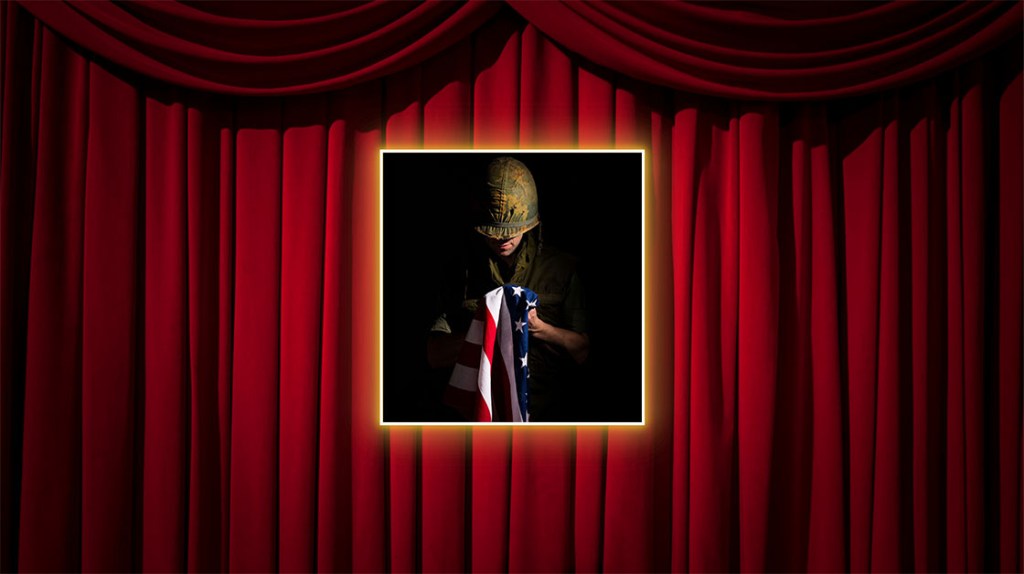
Richard Vergette writes and performs an original work about the emotional and psychological collateral damage of the Vietnam War. Vietnam has become the most cinematic and controversial conflict of the twentieth century, and as a cinephile I approached this work with a heightened sense of familiarity.
Vergette portrays ‘Dutch’, a young man from Monroe Michigan, who volunteers to join the Marines and serves one tour. Now, in his early seventies, he owns and works in his garage, and is trying (and failing) to understand the recurrent but fractured memories of the demilitarized zone (as well as his personal tragedy at the Battle of Huế). The early monologues establish Dutch as a working-class man, long since retired from his job at Ford, who is postponing his imminent retirement. Mise-en-scène is a workshop with no physical manifestation of the war; a visual which suggests to the audience that there is something incomplete or unfinished within this character.
It takes thirty minutes before Vergette’s script gets to ‘Nam, but the characterisations of Dutch and Alvarado (his Mexican buddy) are well-observed and evoke authentic representations of camaraderie in battle. Using his experiences in the war to inform and analyse Dutch’s current radicalisation under Trump, Vergette skilfully prevents his script becoming another in the ‘war is hell’ sub-genre, by recontextualising Dutch’s disillusionment with ‘Merica as decades old PTSD.
There is a great difference between a solo show that draws heavily on the performer’s own life, and one that is a fabrication drawing on thousands of hours of research, interviews and archival footage, with the overarching aim of using the past to help a current generation understand and navigate recent tumultuous developments. Vergette is believable as a veteran, and whilst his conversations with the other characters are well-rendered, he avoids distracting us with outright impersonations. It almost feels as though an old mechanic is telling his story, rather half-heartedly, instead of a tour-de-force of regional American accents.
These are minor quibbles because Vergette’s decade-spanning story interacts with the America of BLM, and Trump, and it builds to a powerful climax which is rendered more clearly and profoundly than any of the other images in the play. This is not merely a serious work derived from contemporary events but it aspires to something more transformative by cleverly establishing the events of five decades ago within the locus of recent events.
 Gonzo Magazine
Leave a comment